
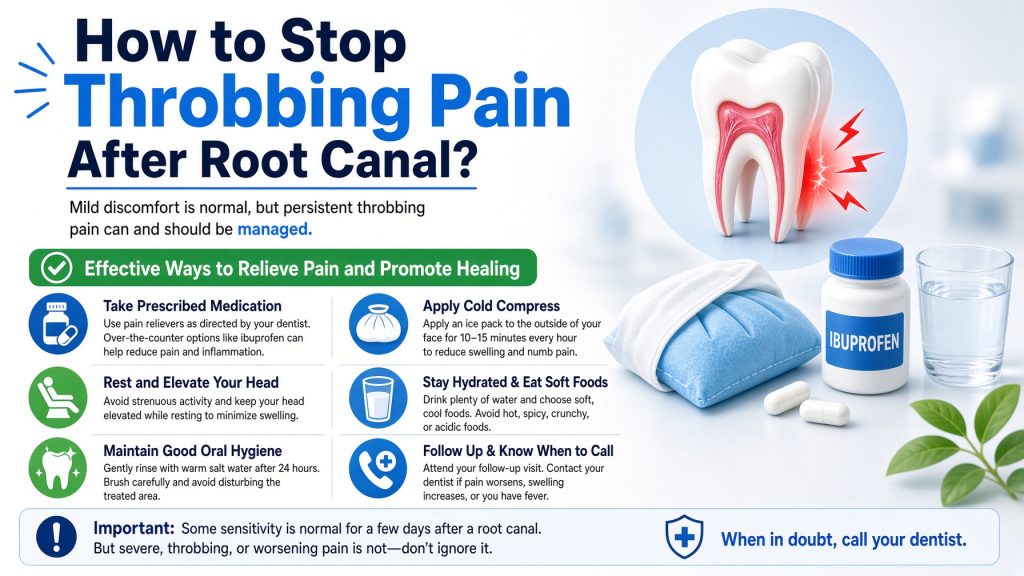
How to Stop Throbbing Pain After a Root Canal?
If your tooth is aching after treatment, you are probably searching for how to stop throbbing pain after a root canal. Some throbbing is a normal part of healing and usually peaks within the first 24 to 48 hours, but there are proven ways to calm it down faster — and clear signs that tell you when to call your Madison, WI dentist instead of waiting it out.
Understanding Throbbing Pain After a Root Canal
A root canal removes the infected pulp from inside your tooth, but the ligament and bone surrounding the root stay inflamed from the procedure itself. That inflammation — not the tooth, which no longer has a living nerve — is what creates the deep, rhythmic throbbing most patients feel for the first few days after treatment.
Normal healing inflammation: Throbbing typically peaks 24 to 48 hours after your appointment, eases noticeably by day 3 to 5, and resolves within 1 to 2 weeks.
A bite that sits too high: A temporary filling or crown that is even a fraction of a millimetre too tall concentrates every chewing force onto the healing tooth. This is the single most common reason throbbing pain after a root canal refuses to settle.
Pre-existing infection: If the tooth was abscessed before treatment, the surrounding bone needs longer to calm down, and discomfort can run several days past the normal window.
Fast Ways to Stop Throbbing Pain After a Root Canal
Knowing how to stop throbbing pain after a root canal comes down to two things: controlling inflammation and keeping pressure off the tooth while it heals. Every step below is safe to start the same day as your appointment.
- Anti-inflammatory medication on a schedule: Ibuprofen controls throbbing better than a painkiller taken only when pain spikes — take it at regular intervals for the first 48 hours, following the label or your dentist instructions.
- Cold compress, 15 minutes on and 15 minutes off: Apply an ice pack wrapped in a thin towel to the outside of your cheek during the first 24 hours to constrict blood vessels and reduce swelling.
- Sleep with your head elevated: One extra pillow lowers blood pressure at the tooth and is often the difference between throbbing all night and sleeping through it.
- Chew on the opposite side: Keep all biting force off the treated tooth until your permanent crown is placed.
- Warm salt water rinses after day one: Half a teaspoon of salt in a cup of warm water, two to three times daily, soothes the irritated gum tissue around the treatment site.
- Soft foods for 2 to 3 days: Yogurt, eggs, soup and pasta let the ligament settle without repeated pressure on the root.
Used together, these steps work with your body natural healing process rather than simply masking the pain.
How Long Throbbing Pain After a Root Canal Should Last
Recovery follows a predictable downward curve. Comparing your symptoms against this timeline is the quickest way to tell normal healing from a problem that needs attention.
| Time after treatment | What is normal |
|---|---|
| First 24–48 hours | Peak throbbing and tenderness; the tooth feels bruised and sensitive to touch |
| Day 3 to 5 | Clearly milder; throbbing replaced by dull soreness, mainly when chewing |
| Day 6 to 10 | Occasional tenderness under bite pressure only, no spontaneous pain |
| After 10 to 14 days | Pain should be gone; anything remaining should be evaluated |
When Throbbing Pain After a Root Canal Becomes a Concern
Healing pain gets smaller every day. Pain that climbs instead of falls is the signal that something needs to be checked. Contact your Madison dentist promptly if you notice any of the following.
- Throbbing that gets worse after day 3 instead of easing
- Pain that is still severe or unchanged beyond 10 days
- Visible swelling in your face, jaw or gum
- Fever, a bad taste, or discharge near the treated tooth — possible signs of an abscess
- Sharp pain the moment you bite down, which usually means the bite is too high
- Pain that returns weeks or months after it had fully resolved
None of these mean the root canal failed. Most are straightforward to correct, and the earlier they are seen, the simpler the fix.
5 Proven Techniques to Stop Throbbing Pain After a Root Canal
These are the methods dentists rely on most when patients ask how to stop throbbing pain after a root canal at home.
1. Take Anti-Inflammatories on a Schedule, Not on Demand
Throbbing is driven by inflammation, so the goal is to keep an anti-inflammatory level steady in your system rather than chasing pain after it starts. Taking ibuprofen at regular intervals across the first 48 hours prevents the peaks entirely. Ask your dentist what combination and dosage is right for you before your appointment ends.
2. Use Cold in the First 24 Hours, Then Switch to Warmth
Cold constricts blood vessels and limits swelling while inflammation is building, so use an ice pack in 15-minute intervals on the first day. After 24 hours, gentle warmth on the outside of the cheek improves circulation and helps the area clear inflammation more quickly. Using them in the wrong order can make throbbing worse.
3. Keep Your Head Elevated at Night
Throbbing almost always feels worst when you lie flat, because blood pressure at the tooth rises. Propping yourself up with an extra pillow for the first two or three nights reduces that pressure noticeably. For many patients this single change is what finally allows a full night of sleep.
4. Get Your Bite Checked If Chewing Hurts
If pain spikes sharply the instant your teeth touch, the temporary filling is likely sitting too high. The healing ligament is taking the full force of every bite, and no amount of medication will fix that. Adjusting the filling takes only a few minutes and often brings immediate relief — it is worth calling rather than enduring another week.
5. Protect the Tooth Until the Permanent Crown Is Placed
A treated tooth is more brittle until it is fully restored, and a crack under the temporary filling causes throbbing that no home remedy will resolve. Avoid chewing on that side entirely and book your permanent crown within the timeframe your dentist recommends.
What to Avoid While the Throbbing Settles
What you stop doing matters as much as what you start. These habits routinely prolong throbbing pain after a root canal.
- Hard, crunchy or sticky foods: Nuts, ice, hard bread and chewing gum can dislodge or crack a temporary filling
- Chewing on the treated side: Repeated pressure keeps re-irritating the healing ligament
- Very hot or ice-cold drinks: Extreme temperatures aggravate inflamed tissue in the first few days
- Alcohol and smoking: Both slow healing and increase the risk of post-treatment infection
- Delaying the permanent crown: The most common cause of a root canal failing later is a tooth left unprotected too long
- Testing the tooth constantly: Pressing on it with your tongue or finger keeps the area irritated
Frequently Asked Questions
Is throbbing pain after a root canal normal?
Yes. Mild to moderate throbbing for the first few days is expected as the ligament around the root heals. It should peak within 24 to 48 hours and improve steadily after that.
Why does my root canal throb more at night?
Lying flat increases blood pressure at the tooth, which intensifies the throbbing sensation. Sleeping with your head elevated on an extra pillow usually reduces it.
How long is too long for pain after a root canal?
Pain that is still significant after 10 days, or that worsens after day 3, should be evaluated by your dentist rather than managed at home.
Can I take ibuprofen and acetaminophen together after a root canal?
Many dentists recommend combining them for dental pain, but the right choice depends on your medical history and other medications. Ask your dentist before your appointment ends.
Why Choose Northbrook Dental Studio for Root Canal Care in Madison, WI
- Same-day comfort checks: If your bite feels high or your pain is escalating, we keep openings each day so you are seen quickly instead of waiting out the weekend
- 3D cone beam imaging: We can identify extra canals, hairline cracks and lingering infection that cause throbbing which does not resolve on its own
- Experienced clinical team: Dr. Alan Reeves, DDS and our team perform root canal therapy using modern rotary instrumentation for shorter, more comfortable appointments
- Aftercare you can actually follow: Every patient leaves with a written recovery timeline showing what is normal, what is not, and exactly who to call
- Flexible payment options: We accept most major insurance plans and offer financing so treatment is never delayed by cost
At Northbrook Dental Studio, we know that pain after treatment is worrying as much as it is uncomfortable. Our team stays reachable throughout your recovery so that any concern is answered by a clinician rather than a search engine.
Schedule Your Root Canal Follow-Up in Madison Today
If home care is not enough and you still need to know how to stop throbbing pain after a root canal, our Madison, WI team can find the cause and correct it — usually in a single short visit. Whether your bite needs adjusting or the tooth needs a closer look, you do not have to wait it out.
Call Northbrook Dental Studio at (636) 344-0868 or book online to schedule your follow-up and get back to a comfortable, pain-free bite.