
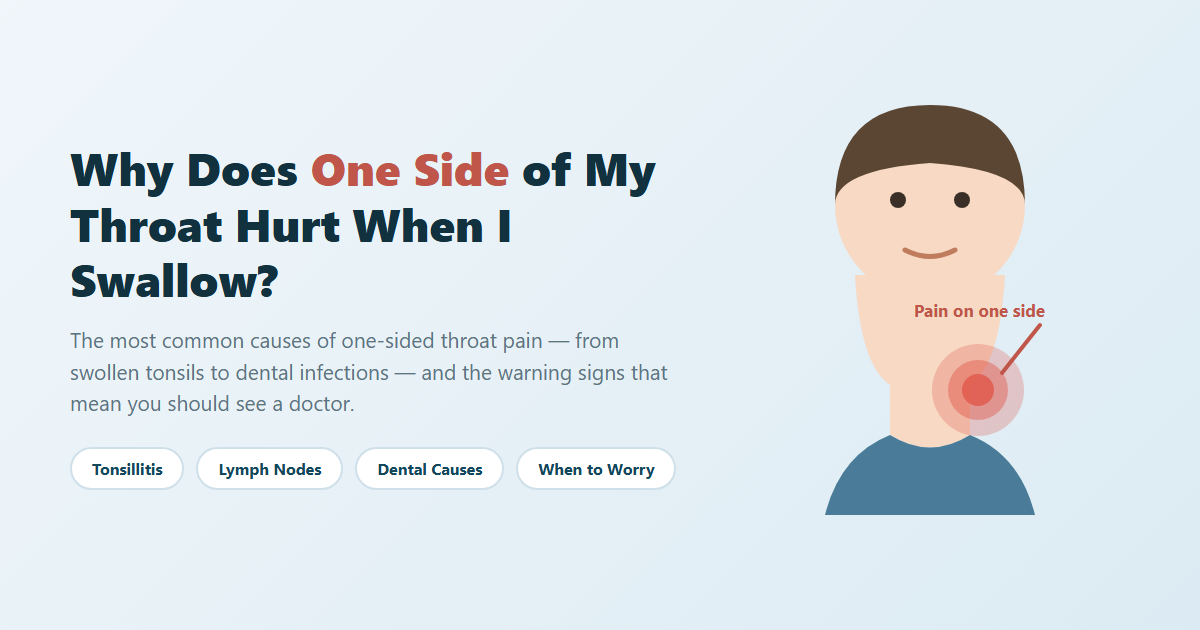
 Why Does One Side of My Throat Hurt When I Swallow?
You wake up, take a sip of water, and there it is — a sharp pain on just one side of your throat every time you swallow. If you’re wondering why one side of your throat hurts when you swallow, here’s the short answer: one-sided throat pain almost always means the problem is localized — one inflamed tonsil, one swollen lymph node, or even an infected tooth radiating pain to that side. Most causes are minor and clear up within a week, but a few need urgent attention. This guide walks you through all of them, what you can safely do at home, and the exact warning signs that mean it’s time to see a professional.
Why Only One Side? The Simple Explanation
Your throat is symmetrical: you have a tonsil on each side, lymph nodes on each side of the neck, and nerves that serve each half separately. When you’re fighting a general virus like a cold, both sides usually hurt. But when the pain stays on one side, it typically means one specific structure is inflamed, infected, or irritated — which actually makes the cause easier to narrow down.
7 Common Reasons One Side of Your Throat Hurts When You Swallow
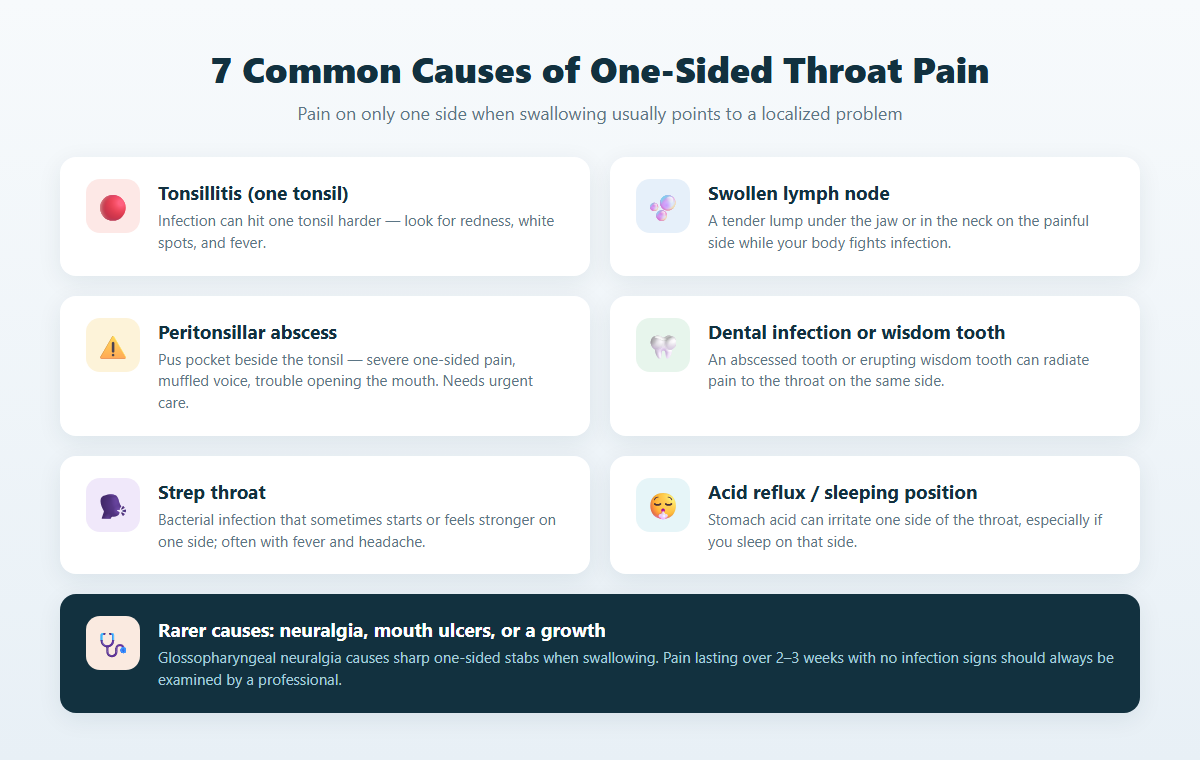
1. Tonsillitis Affecting One Tonsil
Tonsillitis doesn’t always strike both tonsils equally. One tonsil can become significantly more inflamed than the other, causing pain that’s clearly worse on that side when you swallow. Look in the mirror with a flashlight: a red, swollen tonsil — sometimes with white or yellow spots — on the painful side is a strong clue. Viral tonsillitis usually resolves on its own; bacterial cases may need antibiotics.
2. A Swollen Lymph Node
The lymph nodes under your jaw and along your neck swell when your body fights an infection — and often only on one side. If you can feel a tender, movable lump on the painful side, that’s likely a reactive lymph node. It usually settles within two weeks as the underlying infection clears.
3. Peritonsillar Abscess (The One That Can’t Wait)
This is a pocket of pus that forms beside one tonsil, usually as a complication of untreated tonsillitis. The telltale combination: severe one-sided throat pain, a muffled “hot potato” voice, difficulty opening your mouth fully, and sometimes ear pain on the same side. A peritonsillar abscess needs same-day medical care — it must be drained and treated professionally.
4. A Dental Infection or Erupting Wisdom Tooth
This one surprises people: the source of one-sided throat pain isn’t always the throat. An abscessed molar or an erupting (or impacted) wisdom tooth can radiate pain along the jaw to the throat on the same side, and the infection can spread to nearby tissue, making swallowing painful. If your throat pain comes with a toothache, jaw tenderness, bad breath, or gum swelling on the same side, your mouth — not your throat — may be the real problem. Untreated gum infections behave the same way, which is why catching them early matters; we’ve explained the warning signs in our guide to treating gum disease before it spreads. Wisdom tooth trouble in particular is worth a professional look — our oral surgery resources cover when removal becomes necessary.
5. Strep Throat
Streptococcal infection classically causes severe pain, fever, headache, and swollen nodes — and in its early stage it can feel distinctly worse on one side. Strep needs a proper test and antibiotics, so if your pain comes with fever above 101°F (38.3°C) and no cough, get a strep test.
6. Acid Reflux and Sleeping Position
If your throat pain is worse in the morning and improves during the day, silent acid reflux (LPR) could be irritating your throat overnight — often the side you sleep on. A dry room, mouth breathing, or post-nasal drip pooling on one side while you sleep produces the same pattern. The clue: no fever, no swollen nodes, and pain that fades after breakfast.
7. Rarer Causes: Neuralgia, Ulcers, or a Growth
Glossopharyngeal neuralgia causes brief, electric-shock-like stabs on one side when swallowing, yawning, or talking. A mouth or throat ulcer can also hurt sharply on one spot. And while it’s uncommon, persistent one-sided throat pain lasting more than two to three weeks — especially with a neck lump, ear pain, hoarseness, or unexplained weight loss — must be examined to rule out a growth. Don’t panic, but don’t wait either.
Home Remedies That Actually Help
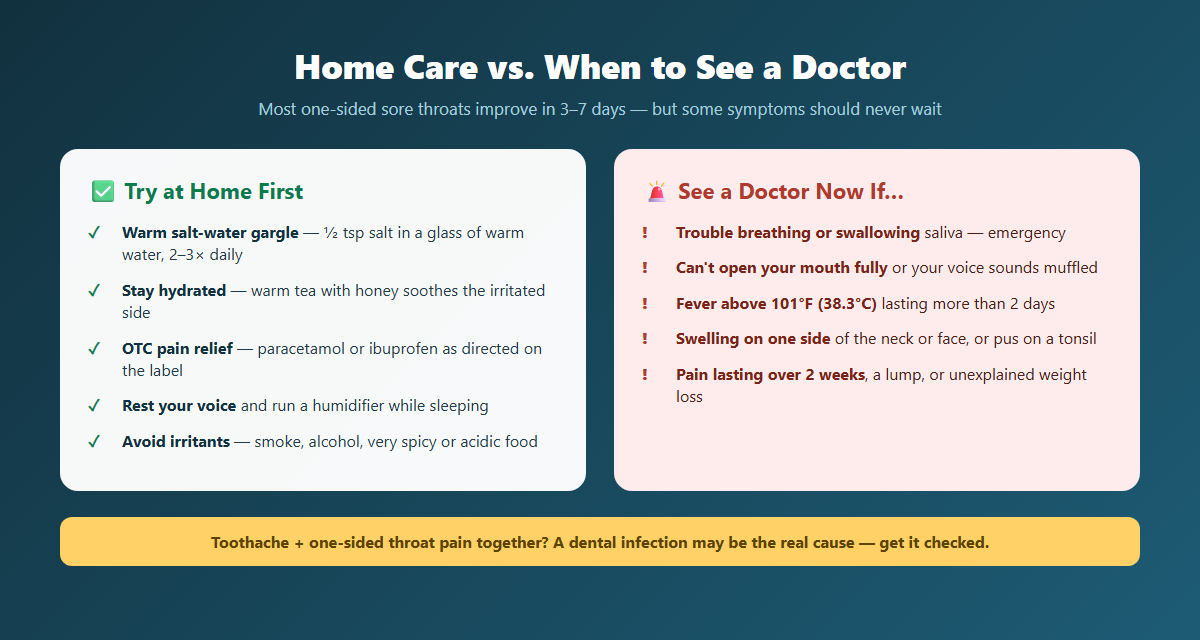
For mild one-sided throat pain without red-flag symptoms, give it three to seven days with this routine:
- Salt-water gargle: half a teaspoon of salt in a glass of warm water, two to three times daily. It reduces swelling and helps clear bacteria.
- Warm fluids: tea with honey, warm broth — they soothe the inflamed side and keep you hydrated.
- Over-the-counter pain relief: paracetamol or ibuprofen as directed on the label eases both pain and inflammation.
- Humidify and rest: a humidifier at night prevents the dry-air irritation that makes mornings worse, and resting your voice helps inflamed tissue recover.
- Avoid irritants: smoking, alcohol, and very spicy or acidic foods all slow healing.
If home care brings steady improvement each day, you’re on the right track. If the pain plateaus or worsens after 48–72 hours, it’s time for a professional opinion.
When to See a Doctor — Don’t Wait on These
Seek medical care the same day if you have: difficulty breathing or swallowing your own saliva, inability to open your mouth fully, a muffled voice, fever above 101°F lasting more than two days, visible pus on a tonsil, or rapidly growing swelling on one side of the neck or face. And see a doctor within a week for any one-sided throat pain that persists beyond two weeks, even if it’s mild.
One more thing people overlook: if your throat pain travels with tooth or jaw pain, book a dental exam, not just a GP visit. Dental infections are a genuinely common hidden cause of one-sided throat pain, and treating the tooth resolves the throat. If you’re in the Atlanta area, our guide on finding a good dentist in Atlanta explains what to look for, or you can simply contact our team to get checked. For more practical guides like this one, browse our Health Tips section.
Frequently Asked Questions
Why does only one side of my throat hurt when I swallow but I’m not sick?
Without fever or other illness symptoms, the most likely causes are acid reflux, dry air or sleeping position, a minor ulcer, muscle strain from coughing or voice overuse — or a dental issue like an erupting wisdom tooth radiating pain to the throat.
Can a tooth infection really cause throat pain on one side?
Yes. An abscessed molar or impacted wisdom tooth shares nerve pathways and nearby tissue with the throat, so infection and pain can spread to the same side of the throat and make swallowing painful. Treating the tooth typically resolves the throat pain.
How long should I wait before seeing a doctor for one-sided throat pain?
If there are no red-flag symptoms, give home care up to one week. See a doctor sooner if pain worsens after 2–3 days, and immediately if you have trouble breathing, can’t swallow saliva, can’t open your mouth, or develop high fever or one-sided neck swelling.
Is one-sided throat pain a sign of cancer?
Rarely — infections and irritation are far more common. But one-sided pain that persists beyond two to three weeks, especially with a neck lump, ear pain, hoarseness, or weight loss, should always be examined promptly. Early evaluation is what keeps rare causes treatable.
Does a peritonsillar abscess go away on its own?
No. It’s a collection of pus that needs professional drainage and antibiotics. Severe one-sided pain with a muffled voice and difficulty opening the mouth warrants same-day medical care.
The Bottom Line
So, why does one side of your throat hurt when you swallow? Because something local — one tonsil, one lymph node, one nerve, or one tooth — is inflamed or infected on that side. Most cases are mild: gargle salt water, stay hydrated, manage the pain, and expect improvement within a week. But trust the red flags — breathing trouble, a muffled voice, high fever, one-sided swelling, or pain that outlasts two weeks all deserve professional eyes. And if your throat pain arrived with a toothache, start with a dental checkup; the answer may be in your mouth, not your throat.
This article is for informational purposes only and is not a substitute for professional medical or dental advice, diagnosis, or treatment. Always consult a qualified healthcare provider about your symptoms.