
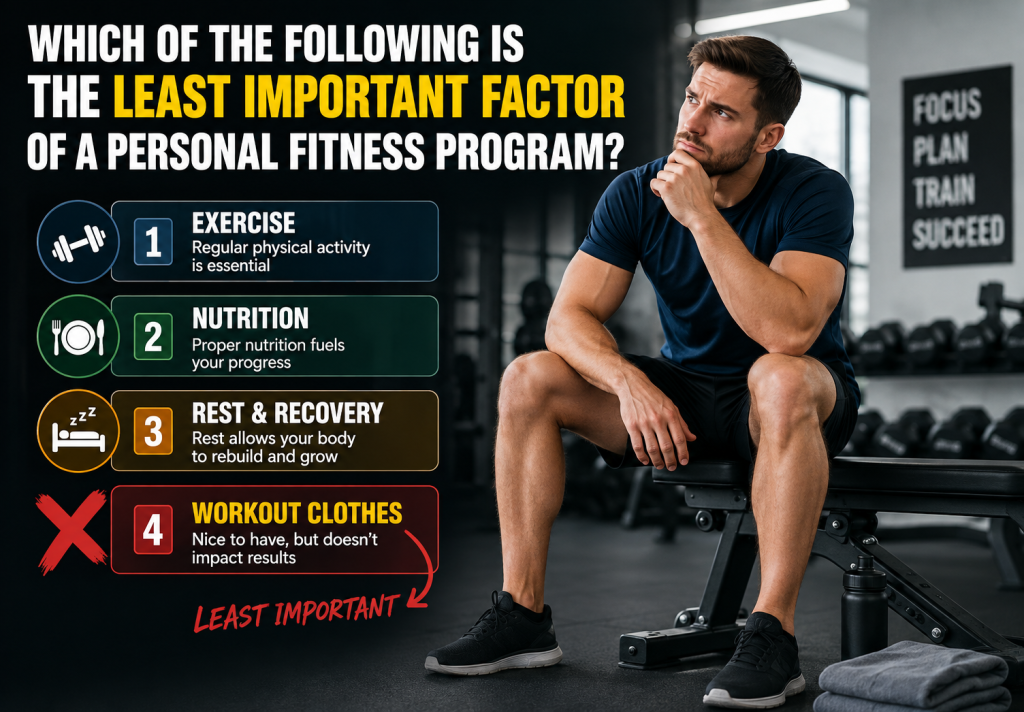
 Which of the Following Is the Least Important Factor of a Personal Fitness Program?
When creating a personal fitness program, it is important to understand which factors have the greatest influence on your health, performance, and long-term success. A good fitness program should be realistic, goal-oriented, safe, and appropriate for your current fitness level. However, people often encounter the question: “Which of the following is the least important factor of a personal fitness program?”
The answer depends on the choices provided in a particular quiz or educational question. In general, factors such as fitness goals, current fitness level, exercise type, frequency, intensity, duration, safety, nutrition, recovery, and consistency are highly important. By comparison, factors that do not directly contribute to achieving your fitness goals—such as following a popular trend or choosing exercises simply because they are fashionable—are generally less important.
Understanding the difference between essential and less-important factors can help you create a fitness program that is practical and effective.
What Is a Personal Fitness Program?
A personal fitness program is a structured plan designed around an individual’s health, fitness goals, abilities, schedule, and preferences. Unlike a generic workout routine, a personal program considers the specific needs of the person following it.
For example, someone who wants to improve cardiovascular endurance may need more aerobic exercise, while someone whose primary goal is building strength may focus more on resistance training.
A well-designed personal fitness program may include:
- Cardiovascular exercise
- Strength training
- Flexibility exercises
- Mobility work
- Rest and recovery
- Healthy nutrition
- Progress tracking
- Goal setting
The program should also be flexible enough to change as the person’s fitness level improves.
Which Factors Are Most Important in a Personal Fitness Program?
Before identifying the least important factor, it helps to understand what makes a fitness program successful.
Fitness Goals
Your fitness goal is one of the most important factors in designing a personal fitness program.
Different goals require different approaches. Common goals include:
- Weight management
- Building muscle
- Increasing strength
- Improving endurance
- Increasing flexibility
- Improving overall health
- Preparing for a sport or competition
For example, a person training for a marathon will require a different program from someone who wants to increase muscular strength.
Current Fitness Level
Your starting fitness level is another essential consideration. A beginner should not necessarily follow the same workout plan as an experienced athlete.
A personal fitness program should account for:
- Current strength
- Cardiovascular fitness
- Mobility
- Exercise experience
- Training history
- Physical limitations
Starting at an appropriate level can reduce the risk of excessive fatigue and injury.
Exercise Selection
The type of exercise you perform should support your goals.
For general fitness, a balanced program may include cardiovascular activity, resistance training, and flexibility or mobility exercises.
The best exercise is not necessarily the most popular exercise. Instead, it should be an activity that is safe, appropriate, and useful for your particular objective.
Frequency
Frequency refers to how often you exercise.
Training too little may make it difficult to achieve your goals, while exercising excessively without adequate recovery can lead to fatigue and reduced performance.
A sustainable program should establish a reasonable training schedule that fits your lifestyle.
Intensity
Intensity describes how challenging an exercise session is.
For example, two people may walk for 30 minutes, but their workouts may have different intensities depending on their pace and fitness levels.
Intensity should generally match the individual’s goals and abilities.
Duration
Duration refers to how long you exercise during a session.
The appropriate duration depends on the activity, intensity, fitness level, and goals. A longer workout is not automatically better.
The quality and consistency of training are often more important than simply spending more time exercising.
Safety
Safety should always be a major consideration when developing a personal fitness program.
A safe program may include:
- Appropriate warm-ups
- Proper exercise technique
- Gradual progression
- Suitable equipment
- Adequate recovery
- Attention to pain or warning signs
People with medical concerns or specific physical limitations may need professional guidance before beginning a new exercise program.
Which of the Following Is the Least Important Factor of a Personal Fitness Program?
If this question appears in a multiple-choice fitness quiz, the correct answer depends on the options given.
However, a factor that has little or no relationship to your individual fitness goals is generally the least important factor.
For example, the color of your workout clothes, the popularity of a particular exercise, or whether your routine looks impressive on social media does not determine whether the program is effective.
By contrast, your goals, fitness level, exercise selection, frequency, intensity, duration, recovery, and safety directly influence the quality of your program.
Therefore, when identifying the least important factor, look for the option that does not meaningfully affect your ability to perform the exercises safely or achieve your desired fitness outcome.
Why Personal Preferences Are Still Important
Although some factors may be less important from a physiological perspective, personal preference should not be completely ignored.
Enjoyment can influence consistency.
For example, if you dislike running but enjoy cycling, cycling may be a better choice for your personal program. Both activities can provide cardiovascular benefits, but choosing an activity you enjoy may make it easier to maintain your routine.
Personal preference becomes especially useful when selecting between several exercises that can accomplish the same goal.
Enjoyment Improves Consistency
A theoretically perfect exercise program is not useful if someone refuses to follow it.
A sustainable fitness program should fit your:
- Schedule
- Interests
- Lifestyle
- Available equipment
- Budget
- Fitness experience
This is why personalization matters.
Popularity Is Not the Same as Importance
One common mistake is assuming that an exercise is valuable simply because it is popular.
Social media can make certain workouts, diets, supplements, or fitness challenges appear essential. However, popularity does not necessarily determine effectiveness.
A personal fitness program should be based on appropriate training principles rather than internet trends.
For example, you do not need to perform every exercise that becomes popular online. Instead, focus on movements and activities that support your goals.
The Role of Consistency in a Fitness Program
Consistency is one of the biggest factors in achieving long-term fitness results.
A person who follows a reasonable program consistently is generally in a better position to make progress than someone who performs extremely difficult workouts only occasionally.
Consistency means regularly participating in your planned activities while allowing enough time for recovery.
A sustainable routine may be more effective than a highly demanding program that quickly causes burnout.
Why Recovery Matters
Exercise creates stress on the body, and recovery allows the body to adapt to that stress.
Recovery can involve:
- Rest days
- Adequate sleep
- Proper nutrition
- Hydration
- Managing training volume
- Light activity between harder sessions
Ignoring recovery can make it difficult to maintain performance and may increase the likelihood of excessive fatigue.
Recovery should therefore be considered when building a balanced personal fitness program.
Nutrition and Hydration
Exercise is only one part of a healthy lifestyle. Nutrition and hydration also support training and recovery.
A balanced eating pattern can provide the energy and nutrients required for normal body function and physical activity.
Hydration is particularly important during exercise, especially when training in hot or humid conditions.
However, nutrition should also be personalized. Energy and nutritional requirements can vary significantly between individuals.
How to Build an Effective Personal Fitness Program
Creating a personal fitness program does not have to be complicated.
Step 1: Define Your Goal
Start with a specific objective.
Instead of saying “I want to get fit,” consider a more measurable goal such as improving endurance, increasing strength, or becoming more physically active.
Step 2: Assess Your Starting Point
Consider your current fitness level, exercise experience, schedule, and limitations.
This helps you choose an appropriate starting point.
Step 3: Select Appropriate Activities
Choose exercises that support your goal.
A balanced program may combine different forms of physical activity rather than focusing exclusively on one type.
Step 4: Create a Realistic Schedule
Determine how many days you can realistically exercise.
A program that fits your schedule is easier to maintain.
Step 5: Progress Gradually
As your fitness improves, your program can gradually become more challenging.
Progression might involve increasing resistance, duration, frequency, or exercise difficulty depending on the goal.
Step 6: Monitor Your Progress
Keep track of relevant measurements such as workout frequency, repetitions, distance, time, or strength.
Progress tracking can help you determine whether your program is working.
Step 7: Adjust When Necessary
Your fitness program should not remain exactly the same forever.
Changes in goals, schedule, fitness level, or preferences may require adjustments.
Common Mistakes When Creating a Fitness Program
Several mistakes can make a personal fitness program less effective.
Choosing a Program Because It Is Trending
A popular workout is not automatically appropriate for you.
Choose activities based on your goals and abilities.
Exercising Too Much Too Soon
Beginners sometimes try to progress too quickly. Gradual progression is generally more sustainable.
Ignoring Recovery
More exercise is not always better. Recovery is an important part of training.
Comparing Yourself With Others
Everyone starts from a different fitness level. Comparing your progress with someone else’s can create unrealistic expectations.
Focusing Only on Appearance
Physical appearance can be one motivation for exercise, but fitness also supports strength, endurance, mobility, functional ability, and overall well-being.
Frequently Asked Questions
What is the least important factor of a personal fitness program?
The least important factor is generally the one that has the least connection to your individual fitness goals, safety, abilities, and progress. The exact answer depends on the choices in the question.
What is the most important factor in a personal fitness program?
There is not always one single most important factor. A successful program usually combines appropriate goals, exercise selection, frequency, intensity, duration, safety, recovery, and consistency.
Why are fitness goals important?
Fitness goals determine what type of training is most appropriate. Someone interested in endurance may require a different routine from someone focused on strength or mobility.
Should a fitness program be based on popular workouts?
Not necessarily. Popularity should not be the primary reason for selecting an exercise. The activity should be appropriate for your goals, abilities, and preferences.
Is consistency more important than doing difficult workouts?
For long-term progress, consistency is extremely important. A sustainable program that you can follow regularly is generally more useful than an extremely difficult routine that you cannot maintain.
Should beginners follow advanced workout programs?
Beginners should generally start at an appropriate level and gradually progress. Advanced programs may be unnecessarily difficult for someone without the necessary training experience.
Final Thoughts
When asking “which of the following is the least important factor of a personal fitness program?”, the key is to identify which option has the smallest impact on your goals, safety, performance, and ability to maintain the program.
Important factors typically include fitness goals, current fitness level, exercise selection, frequency, intensity, duration, recovery, safety, nutrition, and consistency. Factors that are unrelated to these elements are usually less important.
The best personal fitness program is not necessarily the most complicated or fashionable one. It is a program that matches your individual needs, can be followed consistently, and can be adjusted as your fitness improves.
Ultimately, effective fitness comes from making informed choices and building sustainable habits. Rather than focusing on what is trending, focus on what helps you safely move toward your personal goals.