
 I am a college student. Are la roche-posay products better for acne-prone skin than neutrogena?
“I am a college student. Are La Roche-Posay products better for acne-prone skin than Neutrogena?” If you’ve typed that exact question into Google at 1 a.m. after a stressful exam week broke your skin out, you’re in the right place. The short answer: La Roche-Posay is gentler and better for sensitive, easily irritated skin, while Neutrogena gives you stronger actives for less money. The best choice depends on your skin type and your budget — and for most students, the smartest move is actually a mix of both. Let’s break it down properly.
The Quick Answer for Busy Students
If you only read one paragraph, read this one:
- Choose La Roche-Posay if your acne comes with redness, stinging, or sensitivity, or if other acne products have burned or dried out your face. The Effaclar line is formulated for sensitive skin and includes calming ingredients like niacinamide and thermal spring water.
- Choose Neutrogena if your skin is oily and resilient, you want proven actives like 2% salicylic acid or up to 10% benzoyl peroxide, and you’re working with a genuinely tight budget. Most products cost $8–$14.
- Mix both if you want the best value: a cheap Neutrogena cleanser plus one well-formulated La Roche-Posay treatment often beats an all-premium or all-drugstore routine.
Why This Question Matters More in College
College is basically a perfect storm for breakouts. You’re dealing with exam stress, irregular sleep, dining-hall food, shared bathrooms, and pillowcases that don’t get washed as often as they should. Stress raises cortisol, which increases oil production, which clogs pores. So even people who sailed through high school with clear skin often see acne appear (or come roaring back) between ages 18 and 24.
That also means your skincare has to survive real student life: it needs to be simple enough to do when you’re exhausted, cheap enough to rebuy on a student budget, and gentle enough that you can use it consistently without wrecking your skin barrier. Keep that lens on as we compare these two brands.
Are La Roche-Posay Products Better for Acne-Prone Skin Than Neutrogena? The Full Comparison
La Roche-Posay: The French Pharmacy Favorite
La Roche-Posay is a French dermocosmetic brand, and its acne range is built around the Effaclar line. The star product, Effaclar Duo, combines 5.5% micronized benzoyl peroxide with niacinamide and lipo-hydroxy acid. The word “micronized” matters: the benzoyl peroxide particles are smaller, so they penetrate pores more efficiently and tend to cause less surface irritation than standard formulas.
What really sets La Roche-Posay apart is everything around the active ingredients. Most of its formulas include the brand’s thermal spring water (rich in selenium, which soothes inflammation), niacinamide to calm redness, and glycerin or ceramides to support the skin barrier. Translation: the products fight acne while actively reducing the dryness and flaking that acne treatments usually cause.
The catch? Price. A single Effaclar Duo tube runs about $32–$36. That’s real money when you’re budgeting for textbooks and meal plans.
Neutrogena: The Drugstore Workhorse
Neutrogena has been the default American drugstore acne brand for decades, and for good reason. Its Oil-Free Acne Wash with 2% salicylic acid is one of the most-recommended cleansers by dermatologists, and the Stubborn Acne line offers benzoyl peroxide from 2.5% all the way up to 10% — stronger than anything La Roche-Posay sells over the counter.
Neutrogena’s strengths are availability and price. You can grab it at any Target, Walmart, CVS, or campus store for $8–$14. The actives are proven and properly concentrated. If you’re disciplined about moisturizing, a Neutrogena-only routine absolutely can clear mild to moderate acne.
The weakness is the supporting cast. Many Neutrogena formulas are more basic — fewer soothing ingredients, more potential for dryness, and some products still contain fragrance or drying alcohols that sensitive skin won’t love. That 10% benzoyl peroxide spot treatment works, but it can leave your skin red and peeling if you overdo it, and research shows 2.5% benzoyl peroxide is nearly as effective as 10% with far less irritation.
Ingredient Face-Off: What’s Actually in the Bottle
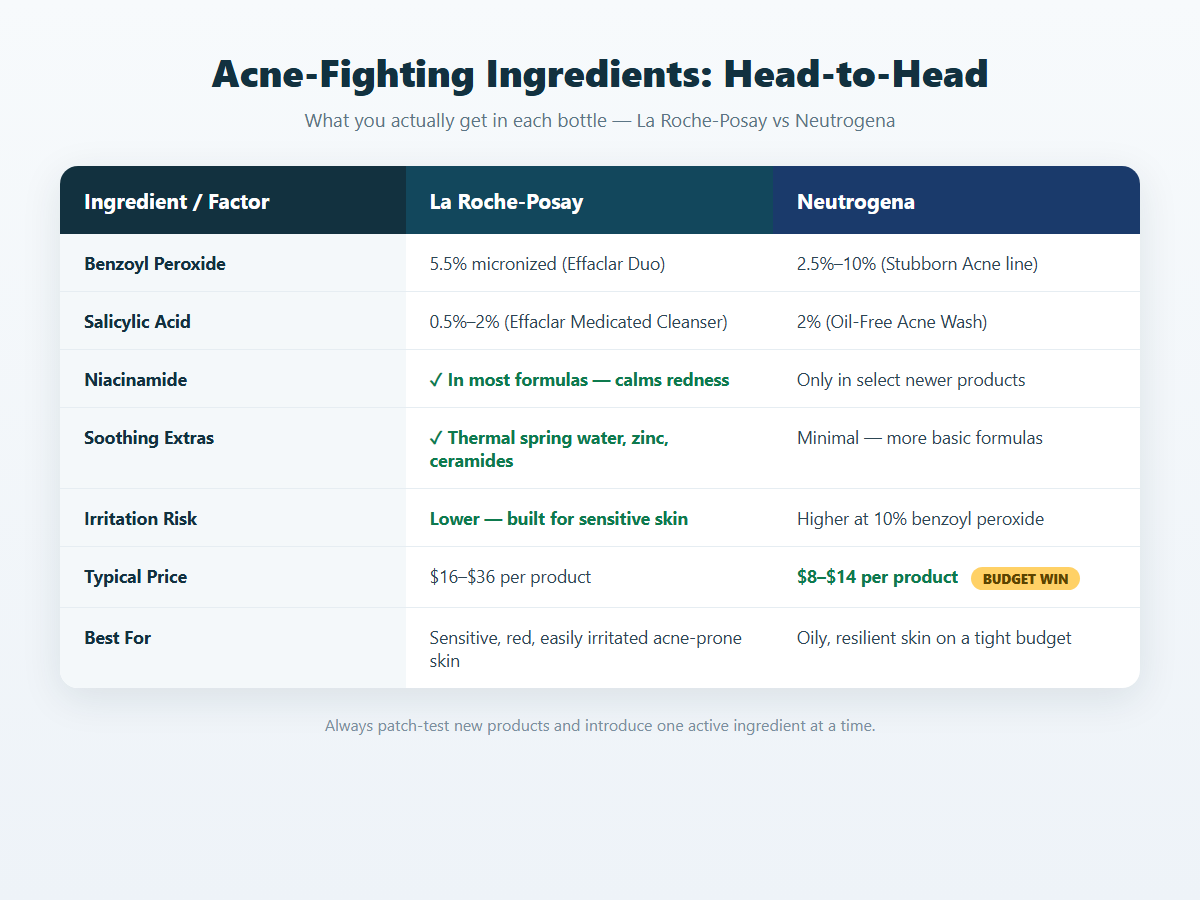
| Factor | La Roche-Posay | Neutrogena |
|---|---|---|
| Benzoyl peroxide | 5.5% micronized (Effaclar Duo) | 2.5%–10% (Stubborn Acne line) |
| Salicylic acid | 0.5%–2% (Effaclar Medicated Gel Cleanser) | 2% (Oil-Free Acne Wash) |
| Niacinamide | In most acne formulas | Only in select newer products |
| Soothing ingredients | Thermal water, zinc, ceramides | Minimal |
| Irritation risk | Lower — designed for sensitive skin | Higher, especially at 10% BP |
| Typical price | $16–$36 | $8–$14 |
| Best for | Sensitive, reactive, combination skin | Oily, resilient skin on a budget |
The Verdict by Skin Type
Sensitive or dry acne-prone skin: La Roche-Posay wins, clearly. The gentler formulations mean you can actually stick with the routine, and consistency — not strength — is what clears acne long-term.
Very oily, resilient skin: Neutrogena wins on value. Your skin can handle the stronger, more stripping formulas, so paying triple for gentleness buys you little.
Combination skin or “I honestly don’t know”: Start with the hybrid routine below. It gives you Neutrogena’s value where formulation matters less (cleanser) and La Roche-Posay’s elegance where it matters most (the leave-on treatment).
The Broke College Student Routine (Best of Both Brands)
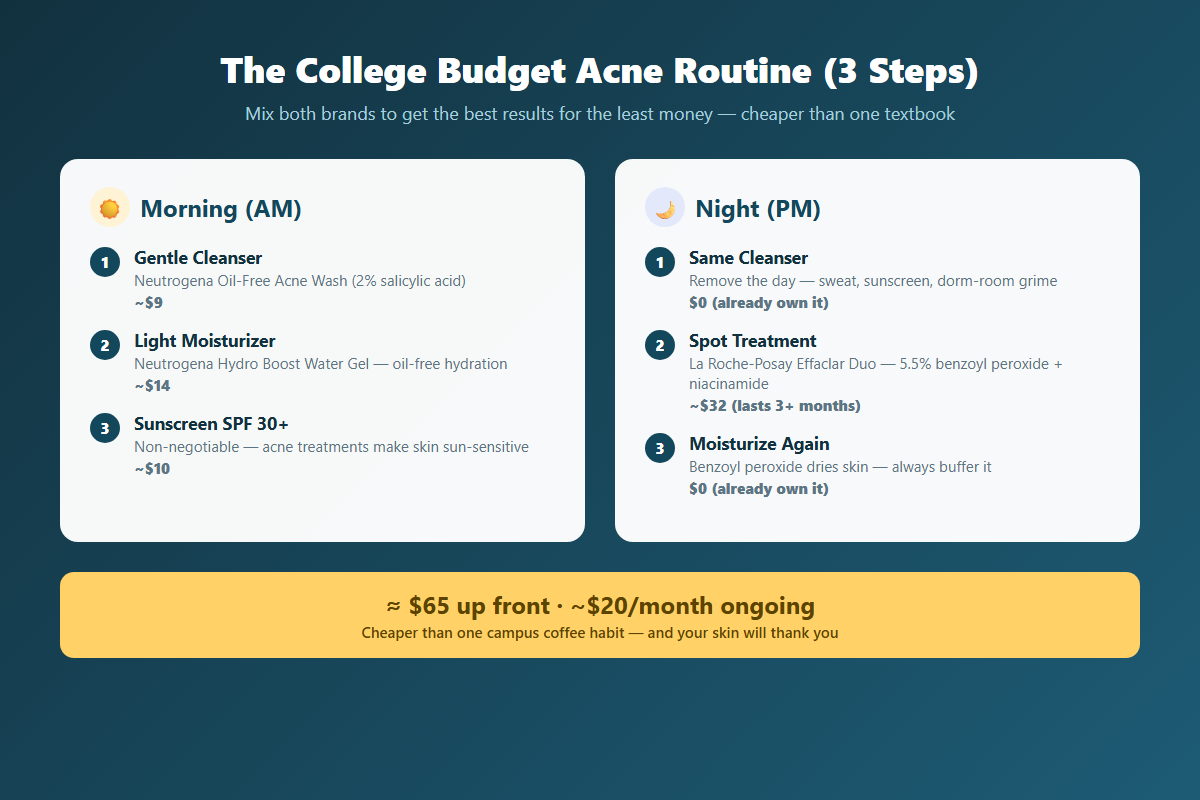
Morning: wash with Neutrogena Oil-Free Acne Wash (~$9), moisturize with Neutrogena Hydro Boost Water Gel (~$14), and finish with any SPF 30+ sunscreen (~$10). Sunscreen isn’t optional — both benzoyl peroxide and salicylic acid make your skin more sun-sensitive.
Night: cleanse again, apply a thin layer of La Roche-Posay Effaclar Duo (~$32, lasts three months or more) to breakout-prone areas, then moisturize on top once it absorbs.
That’s it. Three products, two minutes, twice a day. Give it a full eight weeks before judging results — acne treatments work on the skin cycle, not on your exam schedule.
When Skincare Alone Isn’t Enough
If you’ve been consistent for two to three months and you’re still getting deep, painful cystic breakouts, stop throwing money at drugstore shelves and see a healthcare professional. Prescription options like tretinoin or oral medication are often cheaper through student health services than a shelf full of over-the-counter products.
And remember that skin health is just one piece of overall health — the habits that wreck your skin in college (stress, sugar, skipped sleep, skipped checkups) damage the rest of you too. Your teeth take the same beating from late-night energy drinks and vending-machine dinners. If it’s been a while since your last checkup, our team explains what to look for in finding a good dentist in Atlanta, and why ignoring early warning signs is costly — the same lesson applies whether it’s a pimple or gum inflammation, as we covered in our guide on how to treat gum disease early.
For more student-friendly wellness advice on a budget, browse our Health Tips section — and if you have questions, feel free to contact us.
Frequently Asked Questions
Is La Roche-Posay worth the extra money for a college student?
For the leave-on treatment, usually yes — Effaclar Duo’s gentler formula means you’ll actually use it daily without irritation, and one tube lasts over three months (about 35 cents a day). For cleansers, save your money and buy Neutrogena.
Can I use La Roche-Posay and Neutrogena products together?
Absolutely. Brands don’t conflict — ingredients do. Just don’t layer two strong actives (like a salicylic acid cleanser plus a 10% benzoyl peroxide treatment plus a retinol) in the same routine when you’re starting out. Add one active at a time.
How long until I see results with either brand?
Expect visible improvement in 4–6 weeks and solid results at 8–12 weeks. Anything that promises overnight results is marketing, not dermatology. If you see zero change after 12 weeks of consistent use, it’s time to see a professional.
Which is better for sensitive acne-prone skin?
La Roche-Posay, without much debate. The brand formulates specifically for sensitive skin, with niacinamide and thermal spring water to offset the irritation from acne actives. Neutrogena’s stronger products can overwhelm reactive skin.
Does stress really cause college acne breakouts?
Yes. Stress hormones like cortisol increase oil production and inflammation, which is why breakouts love finals week. Skincare helps, but sleep, hydration, and stress management are part of the treatment plan too.
The Bottom Line
So — you’re a college student wondering if La Roche-Posay products are better for acne-prone skin than Neutrogena. Here’s the honest verdict: La Roche-Posay makes better-formulated, gentler products; Neutrogena delivers proven actives at half the price. If your skin is sensitive, spend the extra $20 on the La Roche-Posay treatment. If your skin is tough and your budget is tight, Neutrogena will get the job done. And if you want the smartest routine for the least money, combine a Neutrogena cleanser with a La Roche-Posay treatment, wear sunscreen every day, and give it eight consistent weeks. Your skin — like the rest of your health — rewards boring consistency over expensive experiments.