
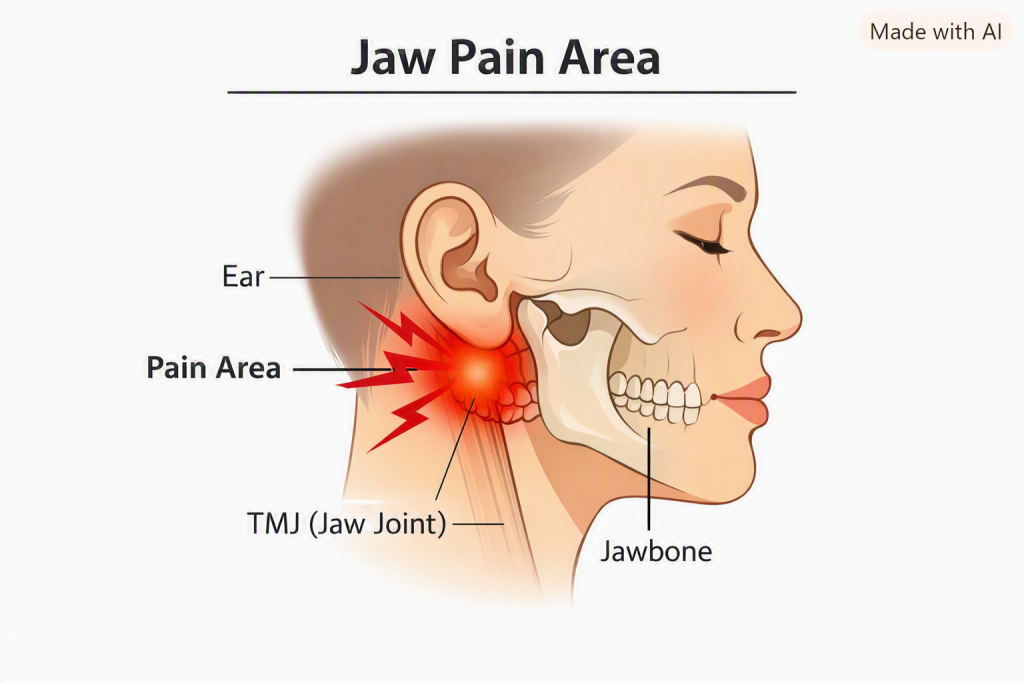
Pain Under Ear Behind Jaw Bone Left Side
- Chest pressure, tightness or pain — especially if it spreads to the left arm, shoulder or back
- Breathlessness, cold sweat, nausea, or a feeling of impending doom
- Pain that starts or worsens with exertion and eases with rest
- Trouble breathing or swallowing, drooling, or swelling spreading under the tongue or down the neck
- Sudden facial droop, slurred speech, one-sided weakness, or sudden vision loss
Pain under the ear behind the jaw bone on the left side most often comes from one of five structures crowded into that small space: the temporomandibular joint (TMJ), the lower left wisdom tooth or a dental infection, a swollen lymph node at the angle of the jaw, the parotid salivary gland, or the ear itself. Which one it is usually shows in what makes it worse — chewing points to the joint or a tooth, swallowing points to a node or the throat, eating a sour or sharp-tasting food points to the salivary gland, and tugging the earlobe points to the ear canal. Left-sided pain deserves one extra check that right-sided pain does not: jaw pain can be referred cardiac pain, so anything that comes with chest pressure, breathlessness or exertion is an emergency, not a dental problem.
What is actually under there
“Under the ear, behind the jaw bone” is one of the most anatomically crowded few centimetres in the body. A joint, a large salivary gland, a cluster of lymph nodes, the mastoid bone, several nerves and the carotid artery all sit within about three finger-widths of each other. That crowding is exactly why this pain is so hard to place — and why pinpointing where it hurts narrows the list faster than describing how much it hurts.
Tap a numbered point on the diagram to see what sits there and what that structure feels like when it is the problem.
Why the left side is worth treating differently
For almost every cause on this page, left versus right is decided by nothing more interesting than which side you chew on, which side you sleep on, or which tooth happens to be decayed. There is one exception, and it is the reason this page exists separately from a right-sided one.
The heart refers pain to the left jaw. The heart has no pain fibres of its own that the brain can localise. Its sensory signals enter the spinal cord at the same levels that serve the jaw, neck, shoulder and arm — so the brain misfiles cardiac pain into those areas. Referred cardiac pain lands on the left jaw and left arm far more often than the right.
What makes it cardiac rather than dental: it is a pressure, tightness, heaviness or burning rather than a sharp point of pain; you cannot reproduce it by pressing on the jaw or by chewing; it comes on with exertion, stress or a heavy meal and eases with rest; and it usually brings a companion — breathlessness, sweating, nausea, or arm and back pain. A tooth or joint problem does the opposite: you can usually find it by pressing, and chewing makes it worse.
A second left-sided exception is carotid artery dissection — a tear in the artery wall in the neck. It causes sudden one-sided neck and jaw pain with headache, sometimes a drooping eyelid and small pupil on the same side. It is rare, but it is a stroke risk and it needs emergency imaging, not a dentist.
Beyond those two, treat left-sided pain exactly as you would right-sided pain: work out which structure it is coming from.
The common causes, and what each one feels like
TMJ disorder (TMD)
The single most common cause
The jaw joint sits directly in front of the ear canal, so joint pain is felt as ear pain remarkably often. People frequently arrive at an ENT clinic convinced they have an ear infection.
- Feels like: dull ache in front of and below the ear, worse through the day
- Worse with: chewing, wide yawning, long phone calls, morning waking
- Clues: clicking or grating, jaw locking, headaches at the temples, worn or sensitive teeth from night grinding
- See: dentist first
Lower wisdom tooth or dental infection
Very common in the 17–30 age group
The lower left third molar sits at the angle of the jaw — the exact spot the keyword describes. An impacted or partly erupted wisdom tooth inflames the gum flap over it (pericoronitis), and the pain refers straight up to the ear.
- Feels like: deep throbbing at the back corner of the jaw, radiating to the ear
- Worse with: biting, hot or cold, lying down at night
- Clues: bad taste, swollen gum flap you can feel with your tongue, difficulty opening wide
- See: dentist urgently if there is swelling or fever
Swollen lymph node
Usually a reaction, not a disease
A cluster of nodes sits right at the angle of the jaw, draining the throat, ear, scalp and teeth. When any of those is infected, the node swells and becomes tender.
- Feels like: a tender, mobile, pea-to-grape-sized lump you can roll under your fingers
- Worse with: pressing on it, turning the head
- Clues: a sore throat, cold or dental problem in the days before
- See: a doctor if it is hard, fixed, painless, or still there after 2–3 weeks
Parotid gland problems
The gland that wraps around the jaw
The parotid is the largest salivary gland and it sits in front of and below the ear, draped over the jaw bone. A stone blocking its duct, or an infection in it, produces a very characteristic pattern.
- Feels like: swelling and pressure below and in front of the ear, sometimes pushing the earlobe outward
- Worse with: eating — especially the first mouthful, or anything sour
- Clues: dry mouth, a gritty taste, visible puffiness that comes and goes with meals
- See: a doctor or ENT specialist
Ear infections
Outer, middle, or the bone behind
Outer ear infection (otitis externa) hurts when you tug the ear. Middle ear infection gives pressure and muffled hearing. Infection spreading into the mastoid bone behind the ear is the dangerous one.
- Feels like: deep ear pain, fullness, reduced hearing
- Worse with: pulling the earlobe or pressing the little flap in front of the canal
- Red flag: redness, swelling and tenderness over the bone behind the ear, ear pushed forward, fever — go to urgent care the same day
- See: a doctor or ENT specialist
Muscle and myofascial pain
Often missed entirely
The masseter, the medial pterygoid and the sternocleidomastoid all attach near this area, and all of them refer pain into the ear when they develop tight, tender bands.
- Feels like: aching, tight, hard to point to with one finger
- Worse with: stress, clenching, poor desk posture, after long dental work
- Clues: pressing a specific spot in the muscle reproduces the ear pain exactly
- See: dentist or physiotherapist
Eagle syndrome
Rare, and famously missed
A styloid process that is longer than normal, or a stylohyoid ligament that has calcified, presses on nerves deep behind the jaw. It is worth knowing about because it is repeatedly misdiagnosed as TMD for years.
- Feels like: sharp, stabbing, electric pain deep behind the jaw angle
- Worse with: swallowing, turning the head, sticking out the tongue
- Clues: a persistent feeling of something stuck in the throat
- See: ENT or oral & maxillofacial surgeon; a CT scan settles it
Nerve pain
Distinctive once you have felt it
Trigeminal and glossopharyngeal neuralgia produce brief, severe, electric-shock pains rather than a steady ache. Shingles of the ear nerve (Ramsay Hunt syndrome) causes ear pain that precedes a blistering rash.
- Feels like: stabbing shocks lasting seconds, in bursts
- Triggered by: light touch, cold air, swallowing, brushing teeth
- Red flag: ear pain plus facial weakness plus a rash in or around the ear — this needs antiviral treatment within 72 hours
- See: a doctor promptly
Giant cell arteritis
Over 50 only — a sight-threatening emergency
Inflammation of the arteries at the temple and jaw. Its most specific symptom is jaw claudication: the jaw muscles ache and tire partway through a meal, then recover after resting — the same pattern as leg cramp when walking.
- Feels like: jaw tiring while chewing, new persistent headache, tender scalp
- Red flag: any blurring, double vision or transient loss of vision — same-day medical assessment
- See: a doctor the same day. Untreated, it can cause permanent blindness
Pain pattern matcher
Answer four questions about the pattern — not the severity. Pattern is what actually separates these causes. The matcher ranks which structures fit your answers and tells you what usually confirms each one. It is a way of organising what you notice, not a diagnosis, and it cannot see anything a clinician would find by looking in your mouth.
Red flags: what turns this from annoying into urgent
| Act now | What it may be |
|---|---|
| Jaw pain with chest pressure, breathlessness, sweating, nausea, or pain spreading to the left arm, shoulder or back — particularly if brought on by exertion | Heart attack or angina. Emergency services immediately. Do not drive yourself. |
| Difficulty breathing or swallowing, drooling, voice change, swelling under the tongue or spreading down the neck | Deep neck space infection (Ludwig's angina). Airway emergency — emergency department now. |
| Sudden severe one-sided neck and jaw pain with headache, a drooping eyelid, or vision change | Carotid artery dissection. Stroke risk — emergency imaging needed. |
| Facial droop or weakness with ear pain, dizziness, or blisters in or around the ear | Ramsay Hunt syndrome (shingles of the ear nerve). Antivirals work best within 72 hours. |
| Over 50, with jaw muscles tiring partway through a meal, a new headache, tender scalp, or any visual disturbance | Giant cell arteritis. Same-day medical assessment — untreated it can cause permanent sight loss. |
| High fever with redness, swelling and tenderness over the bone behind the ear, or the ear pushed forward | Mastoiditis. Same-day urgent care. |
| Spreading facial swelling, fever, or you cannot open your mouth more than about two finger-widths | Spreading dental infection. Urgent dental or medical care. |
| A hard, fixed, painless lump; any lump lasting more than 2–3 weeks; one-sided hearing loss or a blocked ear that will not clear; numbness of the face or tongue; unexplained weight loss or night sweats | Needs investigation. Most of these turn out to be benign, but the combination of one-sided ear blockage with a persistent neck lump is the classic presentation that should never be watched and waited on. See a doctor within days. |
Urgency checker
Tick everything that applies right now. The checker sorts your answers into three bands — emergency, see someone within days, and reasonable to manage at home first — and one emergency item outranks everything else no matter what else you ticked. Nothing you tick leaves this browser tab.
Jaw function self-check
If your pattern points at the joint or the muscles, these are the three things a dentist measures at the first appointment. Doing them yourself gives you something objective to report — and repeating them in two weeks tells you whether it is genuinely improving or you have just got used to it.
What you can safely do while you wait
This applies only if you have no red flags and the pattern points at the joint or the muscles. It does not apply to a suspected infection, a lump, or anything in the urgent table above.
- Give the joint a fortnight off. Soft food, cut into small pieces. No chewing gum, no bagels, no steak, no ice, no biting into apples. This alone resolves a large share of mild TMD.
- Moist heat for muscle, cold for swelling. A warm damp flannel over the joint and cheek for 10–15 minutes relaxes muscle spasm. If there is genuine swelling or a recent injury, use cold instead.
- Catch yourself clenching. Teeth should only touch when you swallow. Rest position is lips together, teeth slightly apart, tongue on the roof of the mouth. Set a phone reminder for a few days — most people are shocked how often they are clenched.
- Stop the small habits. Resting your chin on your hand, holding a phone with your shoulder, biting your nails or pens, opening packets with your teeth, sleeping face-down on the painful side.
- Support wide yawns. A fist under the chin during a yawn stops the joint reaching the end of its range.
- Over-the-counter pain relief per the label. Anti-inflammatories help joint and muscle pain more than plain paracetamol. Follow the packet, and check with a pharmacist if you take other medicines or have stomach, kidney or heart conditions.
- Fix the desk. Head-forward posture loads the jaw muscles constantly. Screen at eye level, shoulders back.
- Do not force it. No aggressive stretching, no repeatedly popping the joint to “release” it, and no jaw exercises from a video until someone has confirmed what is actually wrong.
Give it two weeks. If it is not clearly better, or it is worse at any point, stop self-managing and get it looked at.
Who to see, and what they will do
| Go to | When | What they can do |
|---|---|---|
| Dentist | Chewing pain, clicking, a suspect tooth, morning jaw ache, grinding | Examines the joint and bite, takes a panoramic X-ray, treats decay or wisdom-tooth problems, fits a night guard |
| Doctor / GP | Lump, fever, sore throat, no dental cause, or you are over 50 with jaw claudication | Examines the head and neck, blood tests, treats infection, refers on, arranges urgent ESR/CRP if arteritis is suspected |
| ENT specialist | Ear symptoms, salivary gland swelling, persistent lump, one-sided hearing loss | Examines the ear, nose and throat directly, ultrasound, needle biopsy of a lump, scans |
| Oral & maxillofacial surgeon | Persistent TMD, suspected Eagle syndrome, complex dental infection | MRI of the joint, CT, joint injections, surgery where needed |
| Emergency department | Anything in the red table above | ECG and blood tests for cardiac pain, airway assessment, urgent imaging, IV antibiotics |
Tests you might be offered
- Panoramic dental X-ray (OPG) — the standard first look at teeth, wisdom teeth and the jaw joints in one image.
- Ultrasound — the best first test for a lump, a lymph node or the parotid gland. No radiation, quick, and it can guide a needle biopsy in the same visit.
- CT scan — bone detail. This is what confirms Eagle syndrome, salivary stones or mastoiditis.
- MRI — soft tissue. Used for the TMJ disc, and for anything suspicious in the gland or deep tissues.
- Blood tests — ESR and CRP are the urgent ones if giant cell arteritis is being considered.
- ECG and troponin — if there is any possibility the pain is cardiac. This is a test done to exclude something, and being offered it is not a sign anyone thinks you are wasting their time.
How each cause is usually treated
| Cause | Usual first-line treatment | Typical course |
|---|---|---|
| TMJ disorder | Jaw rest and soft diet, habit change, night guard, physiotherapy, anti-inflammatories | Most improve within weeks; conservative care is deliberately tried before anything invasive |
| Wisdom tooth / pericoronitis | Cleaning under the gum flap, antiseptic rinses, antibiotics if spreading, extraction | Acute pain settles in days; extraction is planned once the infection is controlled |
| Dental abscess | Drainage plus root canal or extraction — antibiotics alone do not cure it | Rapid relief once drained |
| Reactive lymph node | Treat the underlying infection; the node shrinks afterwards | Often 2–4 weeks to fully settle, which is normal |
| Salivary stone | Hydration, sour sweets to stimulate flow, gland massage; removal or basket retrieval if it will not pass | Days to weeks |
| Otitis externa | Antibiotic or steroid ear drops, keeping the ear dry | Usually about a week |
| Myofascial pain | Heat, posture correction, trigger point work, stress management | Weeks, and it recurs if the habit does not change |
| Eagle syndrome | Nerve-pain medication first; styloid shortening surgery if it persists | Long-standing before diagnosis, often good outcome after |
| Giant cell arteritis | High-dose steroids started immediately, often before biopsy confirmation | Started same day to protect vision |
FAQ
What causes pain under the ear behind the jaw bone on the left side?
The most common causes are temporomandibular joint (TMJ) disorder, a problem with the lower left wisdom tooth or another dental infection, a swollen lymph node at the angle of the jaw, parotid salivary gland inflammation or a blocked duct, and ear infections. Less common causes include muscle trigger points, Eagle syndrome, nerve pain such as trigeminal or glossopharyngeal neuralgia, and — in people over 50 — giant cell arteritis. Left-sided pain has one additional possibility that right-sided pain does not: referred pain from the heart.
Can left jaw pain be a sign of a heart attack?
Yes. The heart's sensory nerves enter the spinal cord at the same levels that serve the jaw, neck, shoulder and arm, so the brain can misplace cardiac pain into the left jaw. It typically feels like pressure, tightness or heaviness rather than a sharp point of pain, cannot be reproduced by pressing on the jaw or chewing, comes on with exertion and eases with rest, and usually arrives with breathlessness, sweating, nausea or arm pain. Call emergency services rather than waiting to see whether it passes.
How do I know if it is my ear or my jaw joint?
Two quick distinctions. Tug your earlobe and press the small flap in front of the ear canal — if that sharply increases the pain, it points at the ear canal. Then place your fingertips just in front of each ear and open and close your mouth — if you feel pain, clicking or grating under your fingers and chewing makes it worse, it points at the joint. Ear infections also tend to bring muffled hearing, fullness or discharge, which joint problems do not.
Why does it hurt when I swallow?
Pain on swallowing shifts attention away from the jaw joint and toward the throat, the lymph nodes at the angle of the jaw, or the styloid process. A sore throat with tender, mobile nodes is by far the most common explanation. Sharp, stabbing pain deep behind the jaw on swallowing, along with a persistent sensation of something stuck in the throat, is the classic pattern of Eagle syndrome, which needs a CT scan to confirm.
Is a lump under my ear behind the jaw dangerous?
Most are reactive lymph nodes responding to a throat, ear or dental infection, and these are tender, mobile and settle over two to four weeks. The features that warrant prompt assessment are a lump that is hard, fixed in place and painless, one that lasts more than two to three weeks, or one accompanied by one-sided hearing loss or a blocked ear, unexplained weight loss, or night sweats. That combination should be assessed rather than watched.
How long should I wait before seeing someone?
Immediately for anything in the emergency list. Within a few days for fever, spreading swelling, a lump, inability to open your mouth properly, or if you are over 50 with jaw pain while chewing. Otherwise, two weeks of sensible self-care — soft diet, jaw rest, heat, stopping clenching habits — is reasonable. If it has not clearly improved by then, or it gets worse at any point, get it examined.
Can stress cause pain under the ear and behind the jaw?
Indirectly, and very commonly. Stress drives daytime clenching and night-time grinding, which overloads the masseter and pterygoid muscles and the jaw joint. The result is a genuine physical problem with a behavioural cause, which is why it responds to habit change, a night guard and jaw rest rather than to painkillers alone.
Why is it worse in the morning?
Pain that is at its worst on waking and eases through the day is the signature of night-time grinding or clenching. Pain that starts mild and builds through the day points instead to daytime overuse — chewing, talking, or a sustained clench you are not aware of. Which way round it goes is one of the most useful things you can tell a dentist.
Can a wisdom tooth cause ear pain?
Yes, and it is one of the most frequent explanations for this exact location. The lower wisdom tooth sits at the angle of the jaw, and it shares nerve supply with the ear region via branches of the trigeminal nerve, so the brain refers the pain upward. A partly erupted lower wisdom tooth with an inflamed gum flap over it commonly presents as ear pain with a bad taste and difficulty opening wide.
Does it matter that it is only on the left?
For most causes, no — the side is usually decided by which tooth is affected, which side you chew or sleep on, or where the infection happens to be. The exceptions are cardiac referred pain and carotid artery dissection, both of which favour the left and both of which are emergencies. Once those are excluded, one-sided pain is entirely expected and is not itself a worrying sign.
Sources
- Cleveland Clinic. Jaw Pain: Common Causes and How To Treat It.
- National Institute of Dental and Craniofacial Research (NIDCR). TMJ (Temporomandibular Joint & Muscle Disorders).
- American Heart Association. Warning Signs of a Heart Attack — including jaw, neck and back discomfort as presenting symptoms.
- NHS. Swollen glands and Temporomandibular disorder (TMD).
- Eagle WW. Elongated styloid process: report of two cases. Arch Otolaryngol. 1937;25:584–587.
- Hunder GG, et al. The American College of Rheumatology criteria for the classification of giant cell arteritis. Arthritis Rheum. 1990;33(8):1122–1128.
- Canto AJ, Canto JG, Goldberg RJ. Time to standardize and broaden the criteria of acute coronary syndrome symptom presentations in women. Can J Cardiol. 2014;30(7):721–728.
- Schiffman E, Ohrbach R, Truelove E, et al. Diagnostic Criteria for Temporomandibular Disorders (DC/TMD). J Oral Facial Pain Headache. 2014;28(1):6–27.